
Smart Travel: Save Money on Short-Term Rental Bookings
Hey there, fellow traveller! Remember when booking a short-term rental (STR) felt like a major financial life hack? You could snap up a massive, stylish apartment in the centre of Madrid or Tokyo for half the price of a cramped hotel room. Fast forward to 2026, and the landscape looks a bit different. Between platform service fees, dynamic pricing algorithms, cleaning charges, and local tourism taxes, that "budget-friendly" stay can quickly balloon into a minor fortune.

But don’t pack your bags for a hotel room just yet! You can still find incredible deals on short-term rentals if you know how the system works behind the curtain. By combining real-world travel hacks with insights from academic literature, we have built the ultimate playbook to help you save serious cash on your next booking.
Grab a cup of coffee, and let's dive into the ultimate guide to saving money on short-term rental bookings.
1. Avoid the "Transparency Trap" by Looking at Total Costs First
Have you ever found the perfect rental for €75 a night, clicked all the way through to the final checkout screen, and watched in horror as the price jumped to €150 a night due to cleaning fees? You are definitely not alone.
A study by Tremblay et al. (2024) analysed what they called the "Airbnb Transparency Effect." When platforms in certain regions (like the European Union) started demanding that hosts show all fees upfront, consumer behaviour changed drastically. While some hosts lowered fees to stay competitive, others simply raised their nightly rates to hide the difference.
If you don't look at the total price from your very first search screen, you may waste hours falling in love with a property that is secretly way outside your budget. Furthermore, listings that have zero separate cleaning fees often initially look more expensive on the map but end up being significantly cheaper at checkout because they aren't trying to sneak any extra fee past you at the last second.
Key Takeaway: Price presentation can significantly influence booking decisions. When available, enable the "show total price" option to compare accommodation costs more accurately, including cleaning fees and other charges.
2. Optimise Your Property Size: Decode the 72% Rule
When you search for a rental, how do you decide how many bedrooms you need? If you are travelling as a couple, do you look for a spacious two-bedroom "just in case" you want extra workspace? Doing this might cost you way more than you think. Research by Bobrovskaya, E., & Polbin, A. found that the size and guest capacity of an apartment determine up to 72% of its initial rental price.
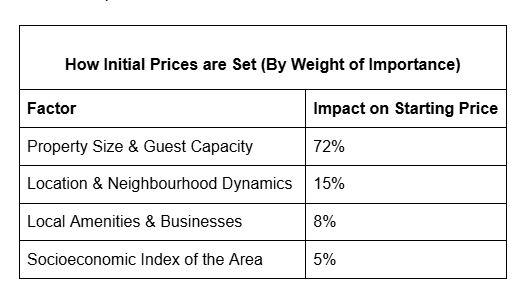

Because size is the absolute heaviest anchor for rental costs, trimming even a tiny bit of unneeded space will yield the biggest drop in your bill.
Don't over-buy capacity: If you are a group of five, don't default to a rental that sleeps eight. Look for a property that sleeps exactly five or six.
Watch out for the "Per-Guest" fee: Many hosts set a low base price for two guests but charge an extra $20–$50 per night for every additional person. Always input your exact guest count before browsing, or you will get hit with a surprise fee later.
3. Outsmart the Dynamic Pricing Algorithms
Far gone are the days when a rental cost the same flat rate every Tuesday in October. Today, almost all professional hosts use automated revenue management software. These algorithms scan the local market every few hours, checking hotel occupancy, upcoming events such as festivals, concerts, conferences in the city, flight data, public holidays and even weather forecasts to adjust the rental price instantly. To save money, you need to understand how these algorithms think. Here is how you can beat the machine:
The "Sweet Spot" Booking Window
Algorithms are programmed to reduce prices if a property isn't booked close to the date. However, they also raise prices if demand is sky-high months in advance.
The Ultra-Early Approach: Book 4 to 6 months in advance only if you are travelling during peak seasons (like Summer in Paris or New Year's Eve in New York).
The Last-Minute Drop: If you are travelling during the shoulder or off-season, wait until 7 to 10 days before your trip. Algorithms automatically slash prices by 15% to 30% to avoid letting the property sit empty.
The Mid-Week Advantage: Most leisure travellers check in on Friday and check out on Sunday. Because of this, weekend rates are heavily inflated. If your work or travel schedule allows it, try booking from Monday to Thursday. You will often get the same luxury property for a fraction of the weekend rate.
4. Join the "Direct Booking" Revolution
Did you know that platforms like Airbnb, VRBO, and Booking.com charge guests a service fee that can range anywhere from 6% to 15% of the total reservation? On top of that, they charge the host a fee, too.
In response, a huge trend has emerged: Direct Booking. Many professional hosts now maintain their own independent websites where they list their properties without the platform middleman.
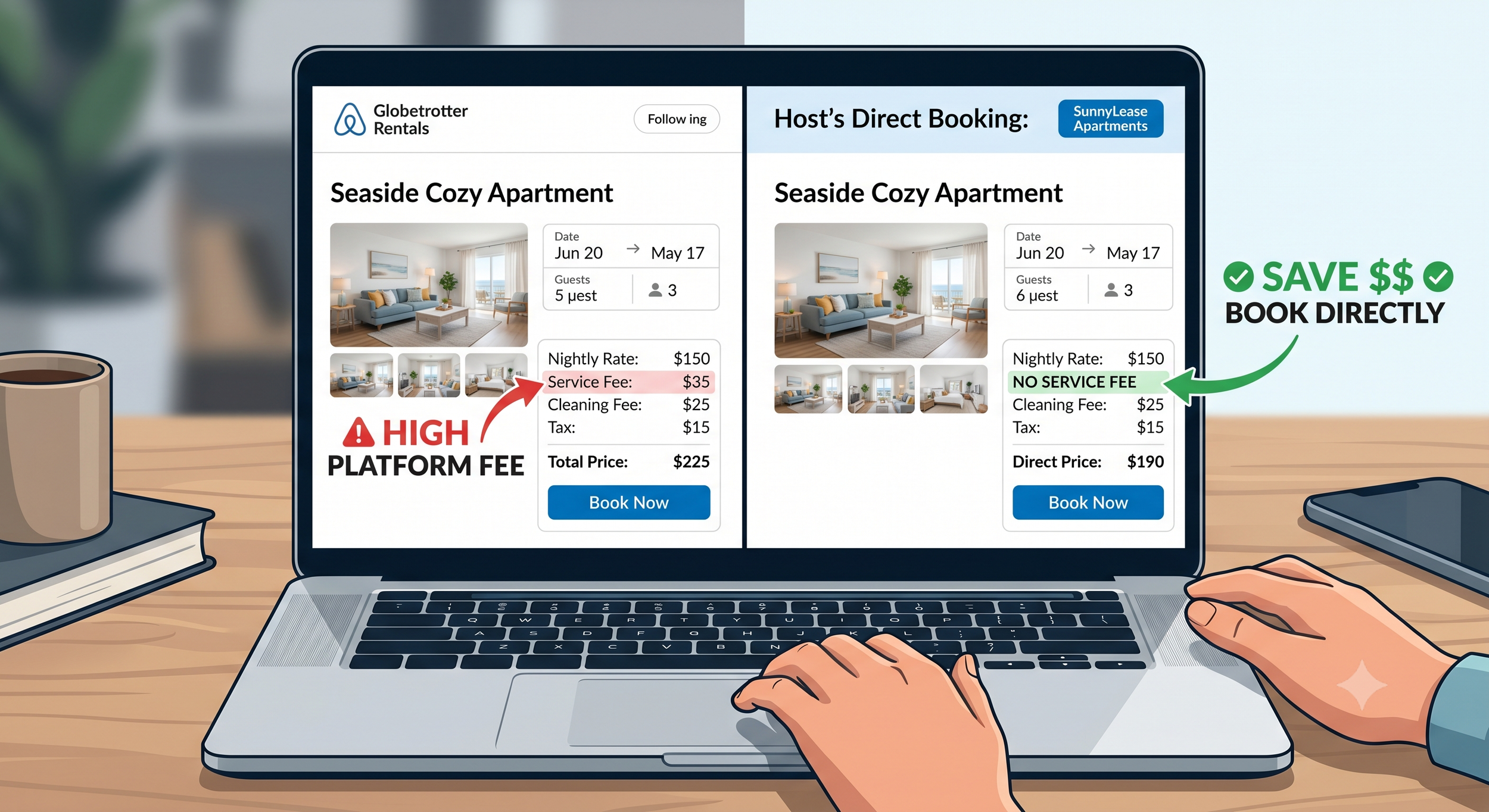
Note: Only book directly if the host has an established website with secure payment processing (such as Stripe or PayPal). Avoid wiring cash or sending money via unverified payment apps.
How to find direct booking options safely:
Find a property you love on a major rental platform.
Look closely at the cover photo or the host's profile for the name of their rental company, e.g., GuestFirst. You can go to their website via any search engine.
If they have a direct website, compare the price. You will almost always save the 10-15% platform service fee instantly!
5. Leverage Extended Stays and the "Gap Night" Trick
The length of your stay has a massive impact on the underlying math of short-term renting. This comes down to fixed costs versus variable costs. Cleaning a house takes the same amount of effort whether you stay for 2 nights or 10 nights. Therefore, longer stays make that cleaning fee much more digestible.
Furthermore, hosts love long-term stability because it reduces their vacancy rates.
The Weekly Discount Sweet Spot: Many hosts offer automated discounts (often 10% to 20%) for stays of 7 days or longer. Remarkably, it is sometimes cheaper to book a place for 7 nights and leave a day early than it is to book it for 6 nights at the full standard rate! Always test adding an extra day to your search to see if a discount tier kicks in.
6. Look Outside the "Tourist Ring"
Geographical research on short-term rentals routinely proves what real estate agents have said for decades: location dictates your expenses. But here is the secret: public transport bridges that gap for pennies. Instead of booking an apartment right next to a famous cathedral or beach, open up a map of the city’s subway or light rail system. Look for neighbourhoods that are 3 to 5 train stops away from the tourist centre.
The Savings: The rental price can drop by up to 40% just by moving fifteen minutes down the train line.
The Bonus: You will experience authentic local restaurants, cheaper groceries, and a quieter night's sleep away from the tourist crowds.
7. Cook Your Own Meals (The Hidden Savings)
While this tip doesn't lower the cost of the booking itself, it is one of the biggest financial advantages of choosing a short-term rental over a hotel.
Eating out three times a day for a family of four can quickly drain a travel budget. By picking a rental with a fully functional kitchen, you can hit a local grocery store on day one. Making your own morning coffee, packing sandwiches for day trips, and cooking just two or three dinners at home can easily save you hundreds of euros over the course of a single week.
Check Your Savings Checklist Before You Book
Before you enter your credit card number for your next trip, run through this quick checklist to guarantee you are getting the absolute best deal possible:
Turned on "Show total price" to avoid hidden cleaning fee surprises.
Matched guest count perfectly with property capacity to beat the 72% size-pricing rule.
Checked for a direct booking website by searching the host's brand name.
Tested shifting dates to mid-week or adding a night to hit a weekly discount tier.
Mapped the property against local transit to see if staying slightly further out saves cash.
Saving money on short-term rentals doesn’t require sacrificing comfort or luxury. It just requires a little bit of strategy, a peek behind the curtain of platform algorithms, and the willingness to look at the numbers like a scientist. Happy travelling, and enjoy keeping those extra dollars in your wallet!
By Nicolette Che
