
7 Signs It’s Time to Hire a Short-Term Rental Property Management Company
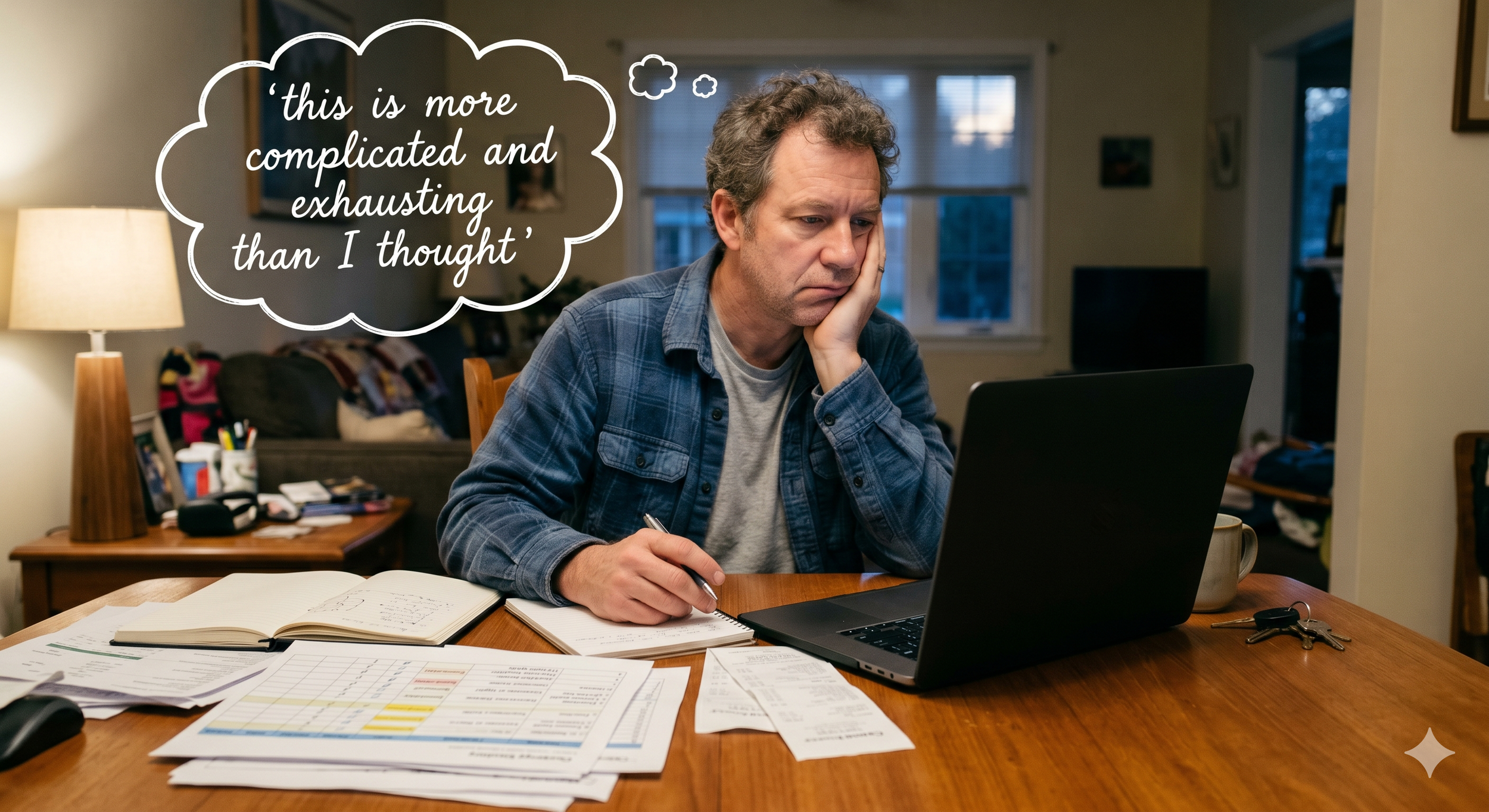
Remember the day you decided to get into the short-term rental market? Maybe you bought a charming condo downtown, or perhaps you converted your own property into a stylish getaway. The vision was well-planned and beautiful: a steady stream of happy travellers, a wave of five-star reviews, and a fat stack of "passive income" hitting your bank account every month.
Hmm. Then reality knocked on your door. Or, more accurately, it buzzed your phone at 2:30 AM.
You suddenly realised that your passive investment had morphed into a demanding, high-stakes hospitality job. You are no longer just an investor; you also need to be a full-time concierge, an on-call handyman, an aggressive digital marketer, a meticulous accountant, and a high-stress cleaning coordinator.
The short-term rental (STR) landscape has shifted dramatically. Travellers aren't just looking for a simple spare bedroom anymore; they expect professional, hotel-grade experiences combined with the local charm of a private home. According to recent hospitality market data, the global vacation rental sector is expanding rapidly, driving up both competition and guest expectations. Managing a single high-performing listing can take several hours of operational labour every single month.
Here are the definitive signs that it is officially time to fire yourself as the daily operator and hire a professional short-term rental property management company.
1. Guest Messaging Has Become a 24/7 Digital Prison
When you first started hosting, replying to a casual inquiry about check-in times felt exciting. But as your booking calendar fills up, the sheer volume of digital correspondence can feel like a relentless tidal wave.
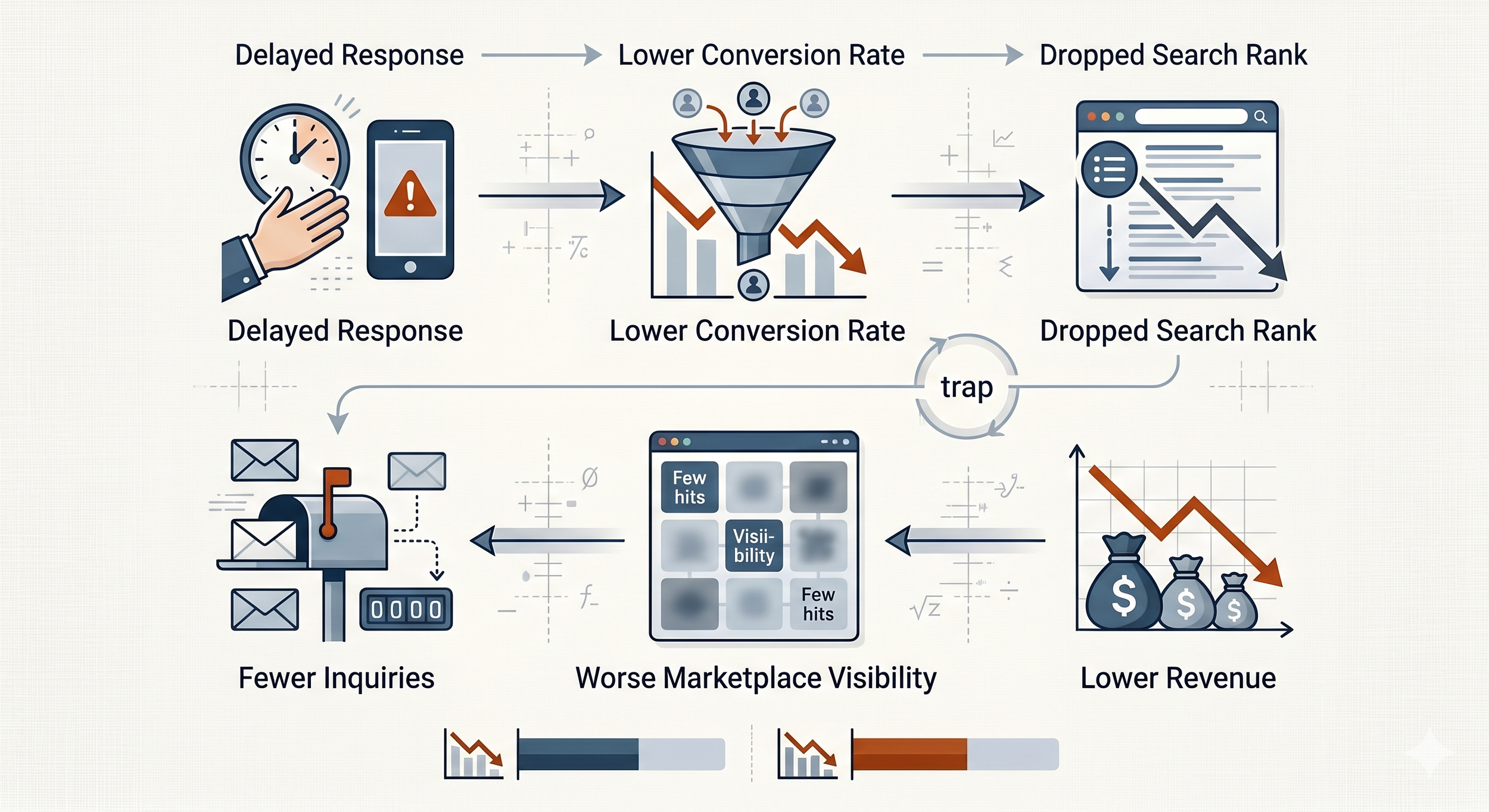
Modern travellers do not just expect answers; they expect immediate answers. Booking algorithms on platforms like Airbnb and Vrbo heavily favour hosts who respond within minutes. If a prospective guest asks a question about your parking situation while you are stuck in a corporate meeting, driving your kids to school, or sleeping, that window of opportunity closes fast. They will simply move on to the next listing that replies instantly.
The 5-Minute Algorithm Trap
But the communication pressure doesn't stop once a booking is confirmed. Guests will message you at midnight because they can't connect to the Wi-Fi, or at 6:00 AM because they can't figure out how to operate the induction stovetop.
If you are experiencing "notification anxiety", where every chime of your phone triggers a mini-spike of adrenaline, it is a clear sign your business model isn't sustainable.
The Professional Advantage
A professional short-term rental management firm completely removes this communicative burden. They employ dedicated, multi-lingual guest experience teams who operate around the clock. By leveraging a mix of specialised hospitality software and live agents, they ensure that every single inquiry, booking request, or midnight complaint is addressed within minutes. Your search rankings climb, your guests stay happy, and you finally get to put your phone on "Do Not Disturb" at night.
2. You Are Trapped in "Turnover Roulette"
In a traditional long-term rental, a tenant moves in and stays for a year or two. You clean the property once during the transition. In the short-term rental world, your property might need to be thoroughly turned over three, four, or even five times in a single week.
This creates a high-pressure operational window. Your current guest checks out at 11:00 AM, and the next guest arrives at 3:00 PM. Within those four hours, the property must be clean and ready:
All linens and towels stripped, laundered, and replaced.
Kitchen appliances cleaned and food remains cleared.
Bathrooms scrubbed, sanitised, and restocked with premium toiletries.
The entire space vacuumed, mopped, and dusted.
A comprehensive inventory check is done to ensure nothing was stolen or broken.
If you are trying to handle these cleanings yourself, you have essentially bought yourself a demanding job as a housekeeper. If you are relying on an independent local cleaner, you may be signing up for uncertainty. What happens if your cleaner gets sick on a busy Friday before a holiday weekend? What happens if they run late, or they don’t show up, and your incoming guests walk into an unmade apartment?
Cleanliness is the number one metric that can make or break an STR listing. A single stray hair on a bedsheet or a dusty shelf can instantly tank a review from a 5-star to a 3-star rating. In a saturated marketplace, a drop in your average cleanliness score will cause your listing to plunge to the bottom of the search results. Property managers bypass this risk entirely by using professional, insured cleaning crews bound by strict hospitality checklists and automated scheduling systems.
3. Your Pricing Strategy Involves Static Guesswork
How do you determine your nightly rate? If you are like most DIY hosts, your strategy probably looks something like this: you set a baseline price for the winter, a slightly higher price for the summer, and maybe bump it up by 20% on Friday and Saturday nights.
Unfortunately, this static approach means you are leaving an enormous amount of money on the table.
Short-term rental pricing is no longer a simple equation; it is a highly fluid branch of economic science known as revenue management. Your optimal nightly rate changes constantly based on some of these variables:
Real-time hotel and STR occupancy rates within a 2-mile radius.
Major local events, concerts, conventions, or sports matches.
Changing flight patterns and airline capacities into your city.
Sudden weather shifts (such as an unseasonably warm weekend boosting beach properties).
Historical booking lead times for your specific neighborhood.
The Double Edged Sword of Bad Pricing
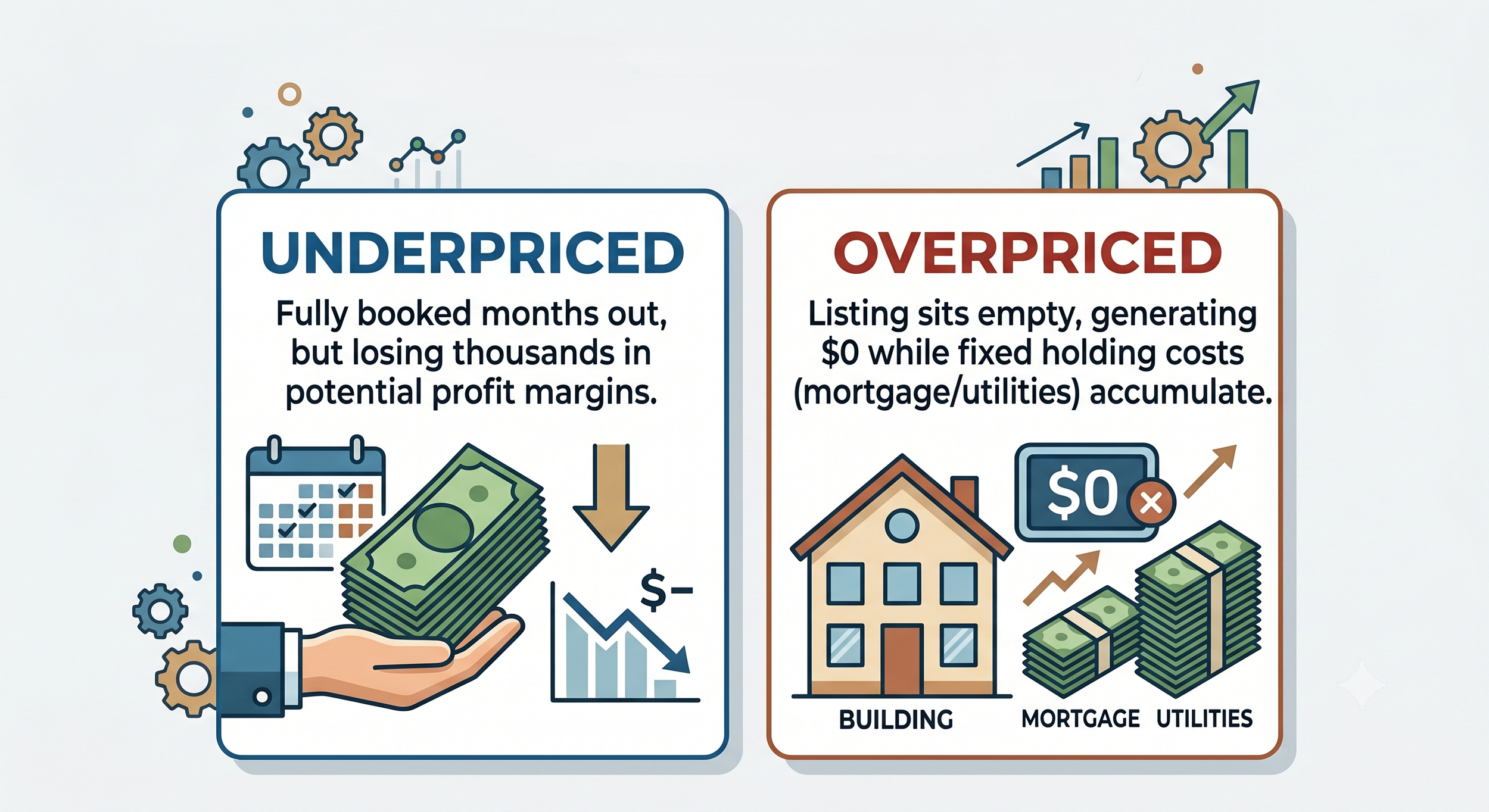
Professional property management companies do not guess. They use sophisticated, AI-driven dynamic pricing engines that analyse thousands of real-time market data points every single day. These tools adjust your nightly rates automatically, sometimes multiple times a day, to ensure your property is priced perfectly. They maximise your occupancy when demand is soft, and aggressively spike your rates when local inventory shrinks, ensuring your total gross revenue climbs significantly.
4. Guest Burnout is Eroding Your True Hospitality Vibe
Hospitality is a beautiful thing, but it can be emotionally exhausting. When you first started hosting, you probably left handwritten welcome notes, curated personalised travel guides, and genuinely looked forward to welcoming your visitors.
But after dealing with your tenth demanding guest of the season, that enthusiasm can turn into frustration. It is hard to maintain a sunny disposition when you have to explain how to use a standard thermostat for the third time in a week, or when a guest leaves a passive-aggressive 4-star review because it rained during their vacation.
The moment hosting stops being fun and starts feeling like an emotional drag, your reviews can reflect it. A great property management company acts as a professional emotional buffer. They handle complaints, navigate the difficult personalities, and enforce boundaries firmly but politely, ensuring your property maintains its highly rated market reputation while you reclaim your peace of mind.
5. You Live in Fear of the Dreaded "Double-Booking"
To maximise your occupancy and reduce your dependency on a single platform, you know that you should list your property across multiple channels—Airbnb, Vrbo, Booking.com, and perhaps your own direct booking website.
However, multi-channel distribution introduces a terrifying operational risk: double-booking.
If a guest books your property for a holiday weekend on Airbnb, and your calendar syncing system lags by even a few minutes, another traveller could instantly book that same date/dates on Vrbo.
Cancelling a confirmed reservation on a major short-term rental platform is incredibly painful. Platforms impose severe financial penalties, permanently strip away coveted badges like "Superhost" status, and intentionally suppress your listing in future search results.
If you are constantly logging into multiple apps to manually block out calendars every time you receive a booking, you are running a reactive, error-prone business. Professional managers use enterprise-grade Channel Managers integrated into centralised Property Management Systems (PMS). These systems utilise instant API connections to update every single platform across the web, immediately a date is secured, rendering double-bookings impossible.
6. Navigating Evolving Regulations and Compliance Requirements
The regulatory landscape for short-term rentals across Finland and Europe continues to evolve as governments seek to balance tourism growth with housing availability and community interests. While short-term rentals remain a popular and legitimate accommodation option, property owners must stay informed about local rules and compliance obligations.
Depending on your property's location, you may need to consider:
Municipal regulations governing short-term accommodation activities.
Registration, licensing, or notification requirements introduced by local authorities.
Value Added Tax (VAT) and other tax obligations that may apply to rental income.
Tourist or accommodation reporting requirements in certain European destinations.
Building, fire safety, and insurance requirements designed to protect both guests and property owners.
Data reporting obligations arising from new European Union regulations affecting online rental platforms.
Property Management Compliance Stack
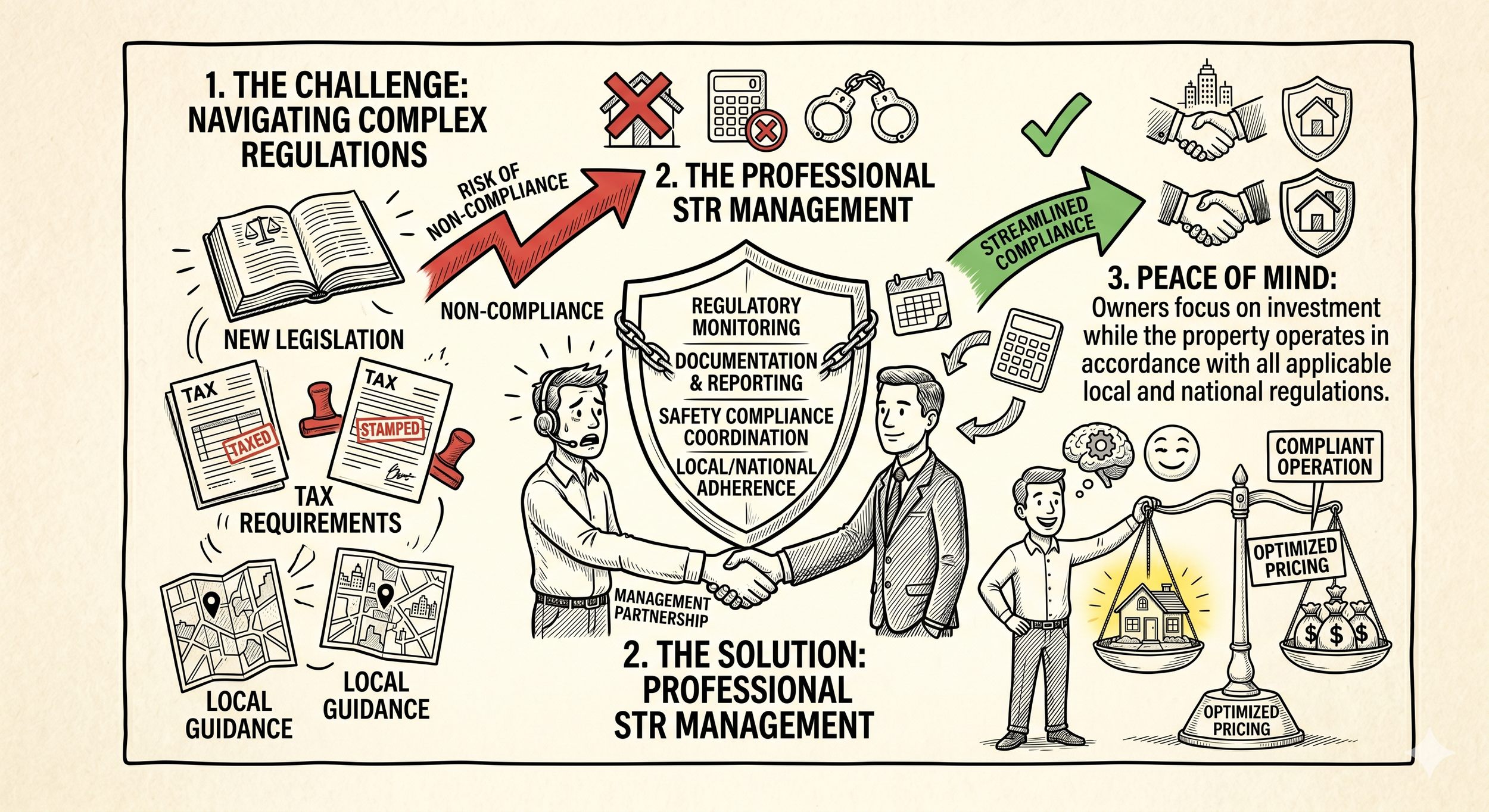
Keeping up with changing legislation, tax requirements, and local authority guidance can be time-consuming, particularly for owners managing properties alongside other personal or professional commitments. Non-compliance may result in financial penalties, administrative complications, or restrictions on rental operations.
A professional short-term rental management company can help simplify these responsibilities by monitoring regulatory developments, assisting with documentation and reporting requirements, coordinating safety compliance measures, and ensuring that your property operates in accordance with applicable local and national regulations. This allows property owners to focus on maximising their investment while maintaining peace of mind.
7. Evaluating Your True Costs: DIY vs. Professional Fees
The most common reason hosts hesitate to hire a manager is the cost. Short-term rental property management companies typically operate on a commission model, charging anywhere from 15% to 35% of the gross booking revenue.
At first glance, giving up a quarter of your revenue can seem painful. But let’s run a quick, realistic mathematical comparison of how the two models actually stack up under professional optimisation:
Comparison of Solo DIY Host Model and Professionally Managed Model
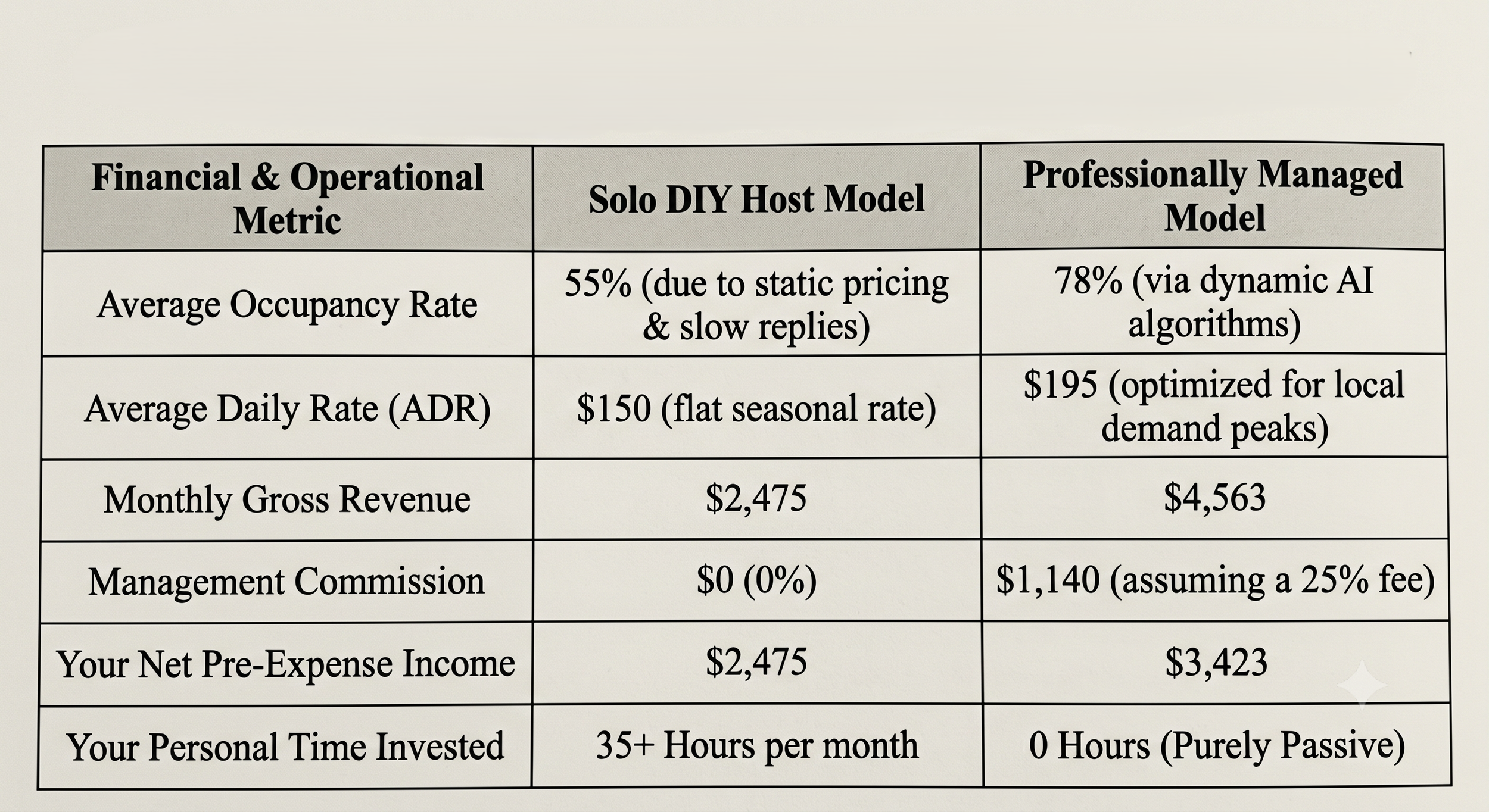
When you hire a top-tier manager, their dynamic pricing strategies, multi-channel marketing, and optimised listing SEO frequently boost a property’s gross revenue so significantly that your net profit can actually end up higher than what you were making as a solo operator. Plus, you get to completely reclaim your weekends, your evenings, and your sanity.
Conclusion: Shifting Your Focus to Wealth Creation
Owning a short-term rental property should serve your lifestyle, not dictate it. If you find yourself constantly stressed by guest messages, overwhelmed by cleaning coordination, or frustrated by stagnant revenue metrics, you are experiencing the clear warning signs of operational burnout.
Handing over the keys to a professional short-term rental management firm is not a sign of failure; it is a hallmark of strategic maturity. It allows you to transform your property from a chaotic, time-consuming job into a highly systemised, truly passive wealth generator. Reclaim your time, protect your peace of mind, and let the professionals turn your rental property into the smooth, hands-free investment it was always meant to be.
By Nicolette Che
